Shamokin, Pennsylvania: From Anthracite Crossroads to City of Opportunity
Indigenous Roots and the Regional Name
The name Shamokin is Indigenous in origin, although historical sources differ on its exact translation. It has been interpreted as “place of eels,” “Eel Creek,” or “place of crawfish.” Because the name passed through several languages and colonial spellings, these meanings are best presented as interpretations.
The large eighteenth-century Native village called Shamokin stood at the forks of the Susquehanna River, in and near present-day Sunbury and Shamokin Dam, not on the site of today's City of Shamokin. It was an important diplomatic and trading center used by Lenape, Shawnee, Haudenosaunee, Tutelo, Saponi, Nanticoke, Mahican, Tuscarora, and other peoples. The later coal city adopted this historic regional name.
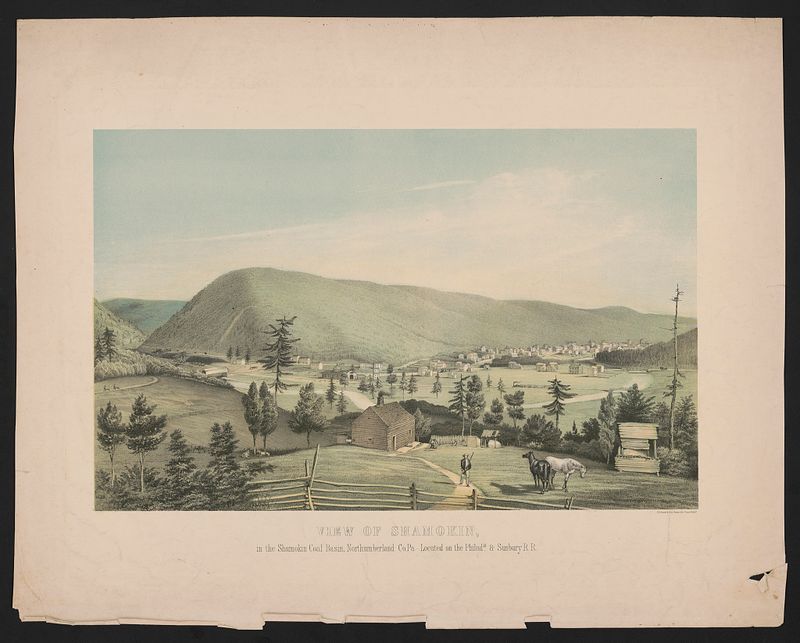
John C. Boyd and Ziba Bird laid out the settlement on March 1, 1835. Early names included Boyd's Stone-Coal Quarry, Boydtown, and New Town. Anthracite coal drove the town's rapid development, while rail connections carried fuel to distant markets.
Shamokin was incorporated as a borough on November 9, 1864, and became a third-class city in 1949.
Historic view: The image beside this section shows early Shamokin developing within its mountain valley.
Coal remained the foundation of the economy, but Shamokin developed a broad industrial base. Railroads supported mines, freight yards, repair work, and commerce. The city also sustained silk and knitting mills, hosiery and garment factories, ironworks, wagon shops, brickyards, breweries, bakeries, dairies, bottlers, and printers. The Eagle Silk Mill became one of the community's best-known industrial landmarks.
Immigrants from Ireland, Wales, England, Germany, Italy, Poland, Lithuania, Slovakia, Ukraine, and elsewhere built churches, schools, beneficial societies, unions, newspapers, clubs, and neighborhood businesses. Their traditions remain central to Shamokin's identity.

Coal break at Shamokin, 1851. James Fuller Queen documented the chutes and railroad cars of the early coal industry. Library of Congress, public domain.

Bird's-eye view of Shamokin, 1884. O. H. Bailey & Co.; Boston Public Library. CC BY 2.0.
Shamokin was one of the communities caught up in the Great Railroad Strike of 1877, the first nationwide labor uprising in United States history.
In July, unemployment, wage cuts, hunger, and dangerous conditions brought miners and railroad workers into the streets. On July 25, after negotiations over emergency street work and wages failed, a crowd estimated at about 1,000 marched through town. The railroad depot was entered and freight was taken. Mayor William Douty assembled an armed citizen force; when the crowd did not disperse, the force fired. Contemporary accounts identify two people killed and about a dozen wounded. Five men were later convicted on charges connected with the disturbance.
The often-repeated figure of more than 100 deaths refers to suppression of the strike across the United States, not to deaths in Shamokin. Locally, the uprising remains a reminder of workers' long struggle for safer conditions, fair wages, and the right to organize.

Shamokin Street at the railroad crossing, 1905. Library of Congress, public domain.
Shamokin natives and residents have made lasting contributions in sports, military service, aviation, government, law, the arts, and public life.

Library of Congress, public domain.
The Hall of Fame pitcher starred for Cleveland and won three complete games in the 1920 World Series. Born in Shamokin, he was inducted into the National Baseball Hall of Fame in 1969.

Library of Congress, public domain.
A successful Major League pitcher for Philadelphia, Cincinnati, and Detroit, Harry was known as the “Giant Killer” after repeatedly defeating the powerful New York Giants.

Library of Congress, public domain.
The Shamokin-born first baseman won National League batting titles in 1913 and 1914 and received the 1913 Chalmers Award, an early equivalent of the league's Most Valuable Player honor.

U.S. Navy, public domain.
A Shamokin native who rose to four-star admiral, Hopwood served as Commander-in-Chief of the United States Pacific Fleet from 1958 to 1960.

U.S. Navy, public domain.
A graduate of Shamokin High School and Naval Aviator No. 13, Richardson became a pioneering engineering test pilot and helped develop early naval aircraft and transatlantic flying boats.

Provincial Archives of Alberta, public domain.
Born in Shamokin, Luchkovich moved to Canada and became the first person of Ukrainian origin elected to the Canadian House of Commons.

Public domain.
Newly added. Born in Shamokin, Cram served as a Union Army colonel during the Civil War and received the honorary rank of brevet brigadier general.

U.S. Courts, public domain.
Newly added. The Shamokin native served as a federal district judge and later on the United States Court of Appeals for the Third Circuit.
These Shamokin-connected figures also carried the community's name into wider fields. A clearly reusable portrait could not be verified for each of them, so they are listed without images.
The Edison Electric Illuminating Company of Shamokin was organized in November 1882. On September 22, 1883, its Independence Street generating station began supplying electric light to customers. Shamokin became an early working example of Edison's three-wire direct-current distribution system.
During his work in Shamokin, the 35-year-old inventor sat for a portrait at Myron Thomas Photography Studios. The Susquehanna River Valley Visitors Bureau identifies it as one of the best-known portraits of Edison.

Thomas Edison in Shamokin, circa 1882-1883. Portrait by Myron Thomas Photography Studios.

The Edison electric station in Shamokin. Historic front view.

The Shamokin Edison station beside the railroad spur. Historic side view.
St. Edward's Catholic Church was one of the system's most celebrated customers. Local tradition long called it the first church in the world lighted by electricity. Because other churches appear to have received electric lighting earlier, that absolute claim is disputed. St. Edward's nevertheless holds an important place as a very early church installation associated with Edison's 110-volt system.
The great sandstone church was destroyed by fire on April 7, 1971. The parish rebuilt, and historic photographs preserve a landmark that once dominated the skyline.

St. Edward's Catholic Church, 1913. Public domain.
Portrait attribution reference: Thomas Edison Illuminated Walking Tour.
On February 22, 1894, delegates meeting in Shamokin founded the Ruthenian National Union, now the Ukrainian National Association. It provided mutual aid and insurance while supporting Ukrainian language, culture, publishing, and civic life across the United States and Canada.
National Ticket Company traces its Shamokin roots to 1907 and grew from a local printing enterprise into a major producer of tickets, credentials, wristbands, and admission products. Churches, beneficial societies, ethnic halls, unions, fire companies, and clubs supplied insurance, burial assistance, education, recreation, and community support.
Edgewood Park opened in 1905 and became a major regional amusement destination. The Victoria Theatre, built in 1917-1918 and designed by William Harold Lee, brought movies and live entertainment to Independence Street. It was listed in the National Register of Historic Places in 1985 but demolished in 1998-1999.

Presbyterian church postcard, before 1923. Presbyterian Historical Society, public domain.

Shamokin High School, circa 1930-1945. Tichnor Brothers Collection, Boston Public Library, public domain.
During the Great Depression, unemployed miners sometimes survived by reopening abandoned workings or digging “bootleg coal” without company authorization. After World War II, competition from oil and natural gas accelerated the decline of deep mining. Mines and factories closed, railroad traffic decreased, and the population fell. Mine fires, polluted streams, abandoned workings, subsidence, and culm banks left a difficult environmental legacy.
Shamokin's later history is also one of adaptation. Residents preserved family businesses, churches, civic organizations, industrial skills, ethnic traditions, and a culture of neighbors helping neighbors.

Sanborn fire insurance map, 1907. Library of Congress, public domain.

Shamokin in its mountain valley, 2014. Jakec/Wikimedia Commons, CC BY-SA 4.0.
Shamokin's buildings, streets, churches, industrial sites, maps, photographs, and family stories show how a Pennsylvania city helped fuel national industrial growth, participated in the history of American labor, adopted electric power at an early date, and gave immigrant communities a place to build institutions of lasting importance.
Preserving this history means telling achievement and hardship together: invention and exploitation, prosperity and danger, immigration and belonging, loss and renewal.